
Fabergé’s Caviar Dish: A Small Luxury Carved in Jade
A silver and nephrite caviar dish in Houston reveals a quieter side of Fabergé, where the vessel could be as intriguing as the delicacy it held.
A caviar dish can outlive the occasion it was made for by a century. The guests disappear, the menu is lost, and the vessel remains, carrying a few stubborn details into the present. One such survivor, in the Museum of Fine Arts, Houston, brings an unexpected material to the caviar table: jade.
The museum attributes its Caviar Dish to the House of Fabergé, dates it to 1908–1917, and places its manufacture in St. Petersburg. Its materials are silver and nephrite. At 18.4 centimetres across its longest dimension and just 3.2 centimetres high, it is a small object with a wonderfully disproportionate capacity to start a conversation. See the museum’s object record.
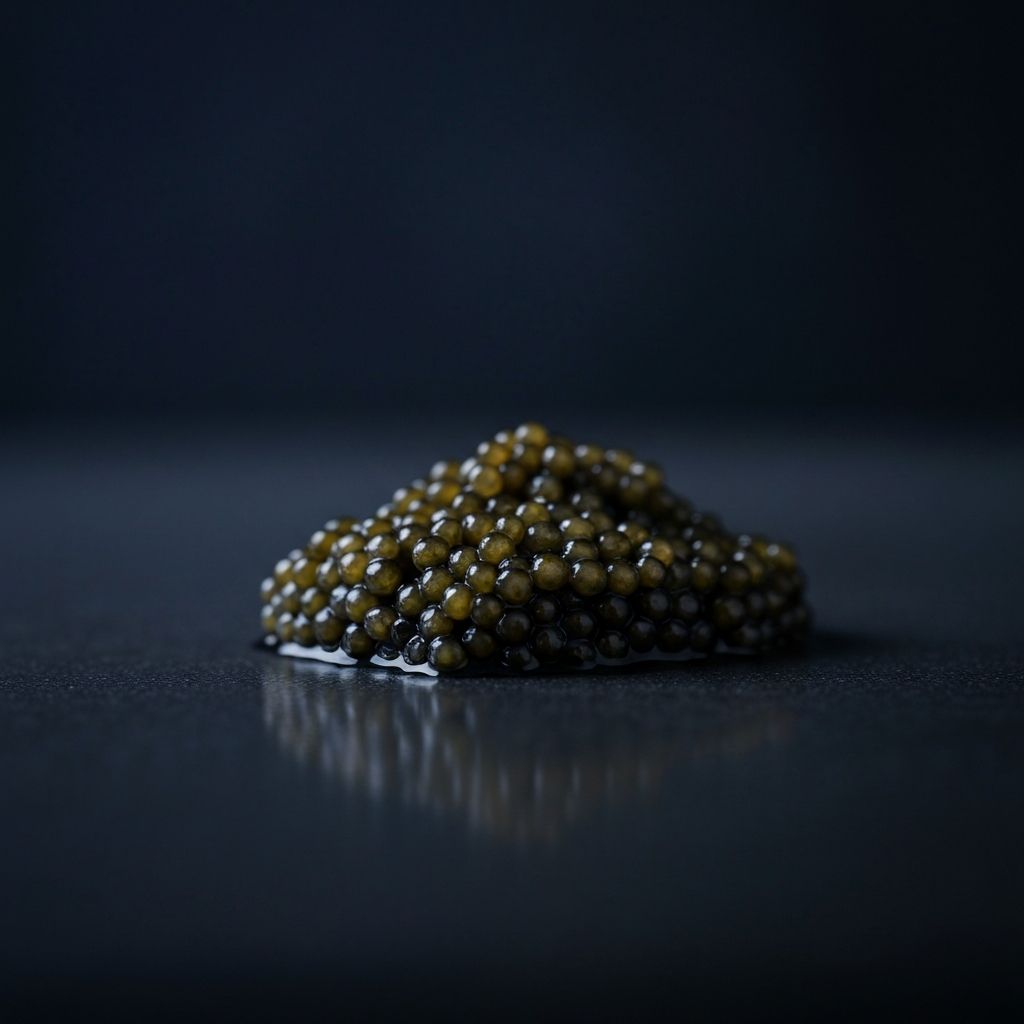
Cover image: an illustrative caviar photograph from our collection. The museum record linked above includes photographs of the artifact.
Jade at the table
Nephrite is one of the two gem materials commonly called jade, the other being jadeite. The Australian Museum describes their tough, microcrystalline structure and long use for carving. It also explains that iron contributes to nephrite’s colour, with higher iron content producing deep green to black shades. Australian Museum: nephrite jade.
That gives the material a role beyond simply looking expensive. A carved stone vessel invites attention to substance, surface and the work needed to shape it. In a caviar setting, the contrast is especially appealing: a food enjoyed in a moment, held by something made to endure.
Beyond the famous eggs
Fabergé’s world extended well beyond ornamental eggs. The Victoria and Albert Museum’s exhibition on the firm’s London business included a cigar box, a cigarette case, animal figures and a painted enamel rose with nephrite leaves. The London branch opened in 1903. These objects place the caviar dish within a much broader culture of exquisitely worked possessions. V&A: Fabergé in London.
A particularly charming parallel comes from the Sandringham commission of 1907. Fabergé made hardstone portraits of animals kept by King Edward VII and Queen Alexandra. According to the V&A, stones were selected for colours and markings that could suggest the animals’ coats and feathers. A dark obsidian became a Dexter bull; other animals brought several stones together. V&A: the Sandringham commission.
What survives in the record
Small details keep this story grounded. The museum records the Fabergé name in Cyrillic on the silver, alongside other marks including the number 84. It identifies the piece as part of the Rienzi Collection, a gift of Mr. and Mrs. Harris Masterson III, and records its donation to the museum in 1996. Its collection number is 96.1316. MFAH catalogue and provenance.
The identity of the first buyer remains an open question in the public catalogue, which dates the dish to a nine-year span.
An object worth bringing into conversation
The pleasure of this dish is its scale. A whole subject opens from a modest table object: stone carving, silverwork, collecting and the attention lavished on presenting a little food.
At a contemporary caviar table, its story offers an unusually good conversation starter. Someone once commissioned or bought a vessel in silver and jade for this delicacy; today, the vessel itself has become the thing we pause to appreciate. The meal has vanished. The craftsmanship still gives us something to savour.
You May Also Enjoy

Caviar Through History
From Persian medicine to the tables of the Tsars, from a nineteenth-century American glut to the collapse of the Caspian and the farms that followed. How a fisherman's food became the world's most guarded luxury.

The Sturgeon Behind the Caviar
A fish older than the dinosaurs, brought to the edge and then back by the industry that nearly ended it. What ethical caviar actually means today.

Beluga vs Oscietra: A Complete Guide
An in-depth exploration of caviar's two most celebrated varieties. Understand their origins, characteristics, and which one suits your palate and occasion.